Welcome to CLPHA's Press Room
CLPHA experts welcome interview requests from print, radio, television, and online reporters and are happy to provide their insights on issues of public housing and related legislation and policy.
For media inquiries, please contact:
David Greer
Director of Communications
(202) 550-1381 or [email protected].
*Please let us know if you are working on deadline.
To view all of CLPHA's press releases, click here.
To view all of CLPHA's press statements, click here.
You can subscribe here to our biweekly newsletter, events invite list, and topic specific newsletters. You can also follow us on Twitter at @CLPHA. Or, send us an email with your interests and we would be happy to add you to our press lists.
Thanks again for your interest in CLPHA!
DHA CEO Anthony Scott Testifies Before House Appropriations Subcommittee on Behalf of the Council of Large Public Housing Authorities: Aggressive Action is Needed to Undertake Affordable Housing Production and Preservation
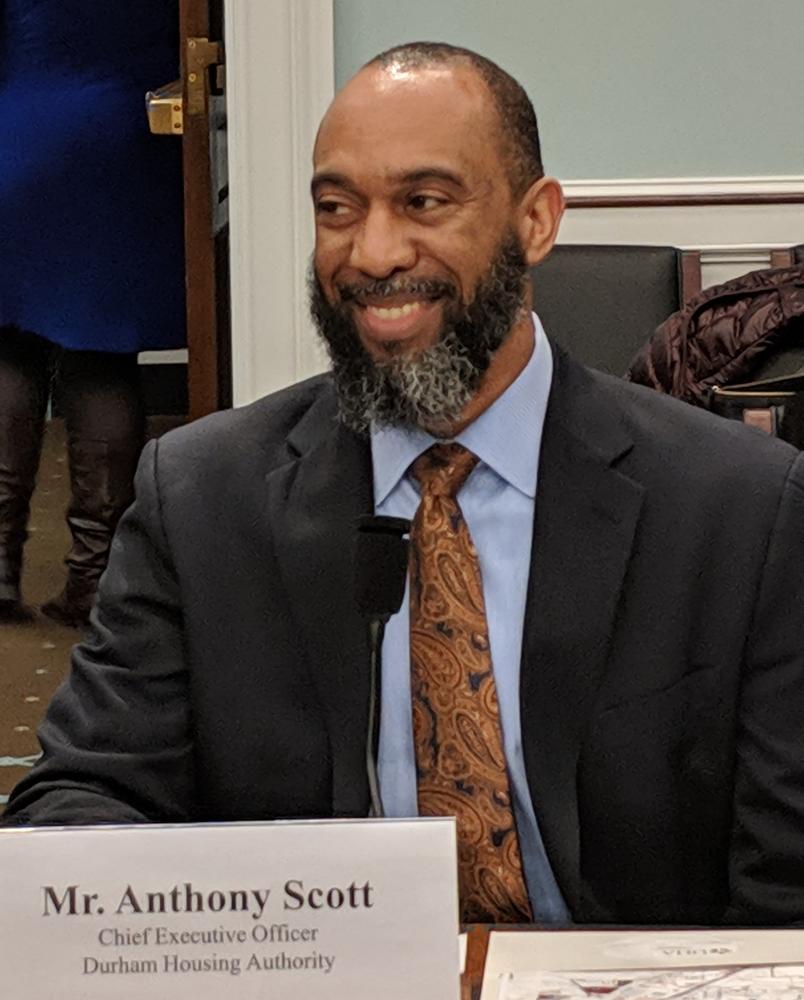
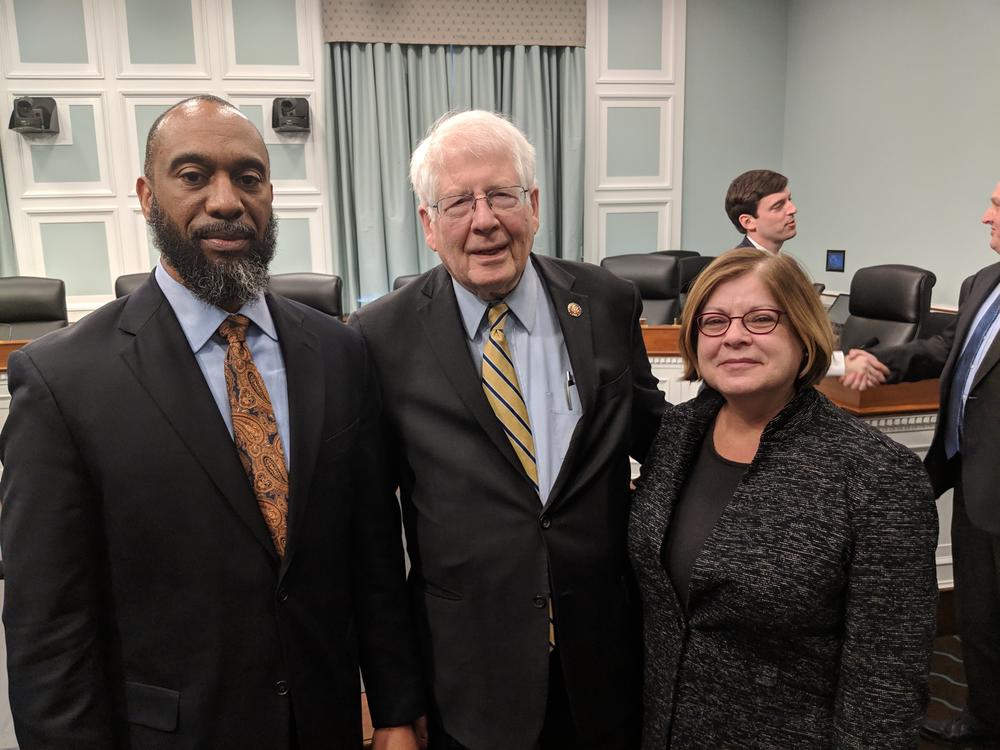
WASHINGTON (March 7, 2019) – This morning, Durham Housing Authority CEO Anthony Scott testified on behalf of the Council of Large Public Housing Authorities before the House Appropriations Subcommittee on Transportation, Housing and Urban Development, and Related Agencies during its hearing, “Stakeholder Perspectives: Affordable Housing Production.” Scott emphasized the critical need for reinvestment in the nation’s Public Housing and Section 8 Housing Choice Voucher programs, which are the foundation of the affordable housing market.
“As a nation, we are now at a critical stage for needing aggressive action to undertake affordable housing production and preservation,” testified Scott.
In addition to calling for increased appropriations to the public housing capital and operating funds, Scott urged Congress to combat the affordable housing shortage by providing housing authorities greater flexibility to preserve and transform public housing through the Rental Assistance Demonstration Program, the Moving to Work program, and with selected and targeted flexibilities through a defined statutory process.
“Fundamentally, the RAD program allows DHA to create mixed-use and mixed-income communities that allow a more diverse socio-economic living environment,” testified Scott. “Our barriers are a RAD program that doesn’t allow enough flexibility to fully leverage development opportunities with private sector development… The private market moves at a faster pace and waiting on a RAD approval to transfer units could result in a missed opportunity.”
Scott also recommended Congress eliminate the Faircloth Amendment, which prohibits the development of new public housing units; invest in broad place-based solutions such as the Choice Neighborhoods Initiative to address neighborhood and community development needs; encourage greater interdepartmental collaboration to facilitate cross-sector partnerships with housing; and distinguish public and affordable housing as an integral part of the national infrastructure.
“We thank Chairman Price for inviting CLPHA and Mr. Scott to participate in today’s hearing, and for recognizing that public housing authorities are essential to local housing markets as the owners and operators of most of the assisted housing that serves extremely low-income households while generating wide reaching economic impacts,” said CLPHA Executive Director Sunia Zaterman. “We look forward to working with the committee to increase support for public and affordable housing programs that provide decent housing to the nation’s most vulnerable citizens, connect low-income workers to economic opportunities, and spur regional job creation and economic growth.”
Along with Scott, representatives from the North Carolina Housing Finance Agency and National Housing Trust were invited to participate in the Appropriations Subcommittee hearing.
The testimony is posted to the Committee website and the live-stream recording of the hearing can be viewed on the Committee's YouTube channel.
About the Council of Large Public Housing Authorities
The Council of Large Public Housing Authorities is a national non-profit organization that works to preserve and improve public and affordable housing through advocacy, research, policy analysis and public education. CLPHA’s 70 members represent virtually every major metropolitan area in the country. Together they manage 40 percent of the nation’s public housing program; administer more than a quarter of the Housing Choice Voucher program; and operate a wide array of other housing programs. Learn more at clpha.org and on Twitter @CLPHA and follow @housing_is for news on CLPHA’s work to better insect the housing field and other areas of critical importance such as health and education.
###
Washington, DC – Members of the Campaign for Housing and Community Development Funding (CHCDF) hosted a national call with over 2,200 registrants yesterday, January 15, about the effects of the partial government shutdown on low-income people and communities and the affordable housing programs that serve them.
Experts from multiple affordable housing organizations shared information on the shutdown’s impact on federal affordable housing and community development programs and emphasized that the longer the shutdown continues, the more negatively it will impact people with the lowest incomes – seniors, people with disabilities, and families with children. Panelists spoke about the shutdown’s effects on public housing, project-based rental assistance, housing vouchers, rural housing, and housing and services for seniors, people with disabilities, the homeless, and those at risk of homelessness.
The panel encouraged listeners to contact their members of Congress and tell them to vote now—before residents in federally assisted housing experience rent hikes and evictions—to reopen the federal government and pass clean fiscal year 2019 spending bills. Listeners were also urged to encourage their members of Congress to sign onto a “dear colleague” letter led by Senator Mark Warner (D-VA) and Representative Marc Veasey (D-TX) to be sent to President Trump on the shutdown’s severe consequences for affordable housing.
“Nearly 700 property owners that have HUD contracts to operate housing affordable to the lowest-income seniors, people with disabilities, and families with children have seen those contracts expire due to the shutdown, and more will expire this month and next,” said NLIHC President and CEO Diane Yentel. “These contract suspensions put the homes of nearly 70,000 low-income renters at risk of serious rent hikes and evictions. HUD has asked owners of these properties to dip into their savings, if they have any, to cover the costs. Some will be able to do so, but not forever, and some have already communicated to their tenants that rent hikes are coming. The longer the shutdown goes on, the more untenable it will become for properties owners to keep scraping by without their federal contracts - and the more the lowest-income renters will suffer.”
“Public housing authorities, which are responsible for housing over 3 million low-income households nationwide, are doing everything they can to keep things running during this period of tremendous uncertainty, but it is unclear how long they can continue with business as usual for residents and landlords,” said Council of Large Public Housing Authorities Executive Director Sunia Zaterman. “Without a guarantee from HUD that funding will be available in March, many PHAs will need to notify landlords and residents next month that delayed payments are a possibility. Anxious residents and landlords fearful of missed payments, combined with other cascading impacts due to lack of staffing at HUD, including program grants not being renewed and affordable housing development deals not being approved, amount to an unmitigated disaster for millions of low-income families.”
“As the budget stalemate continues, the impact on small towns and rural families grows more severe. Everyday Americans are losing out on billions of dollars’ worth of affordable housing, clean drinking water, and community facilities, like town halls, fire stations and hospitals,” said Housing Assistance Council CEO David Lipsetz.
“HUD has made clear already, in December, [it has] not renewed 224 contracts for rental assistance in Section 202 Housing for the Elderly communities, and more are set to expire in January,” said LeadingAge President and CEO Katie Smith Sloan.“LeadingAge’s members, all nonprofits, rely on regular and adequate funding to provide quality affordable housing to some of the nation’s lowest-income older adults. The average older adult in HUD’s Section 202 Housing for the Elderly program has an annual income of $13,300, an income far too little to make ends meet in any private housing market. More than 400,000 older adults rely on the Section 202 program, while another 1.2 million rely on other HUD programs for housing assistance. We urge Congress and the White House to end the shutdown so that . . . these 1.6 million older adults have the stable housing they need to age with dignity.”
“The shutdown’s impacts range far beyond Washington, DC,” said National Association of Housing and Redevelopment Officials CEO Adrianne Todman. “It’s hurting workers, small businesses, farmers, and housing providers across the country. Housing providers are struggling with contingency plans to make repairs to units and to pay landlords in the voucher program. And guess who will suffer the most? The low-income families and seniors who rely on a functioning federal government. They are at risk now and will be at even greater risk as the shutdown continues. If any of these families are harmed by the shutdown, the blame lays squarely at the feet of the White House and the Congress.”
“Every day that it drags on, the needless government shutdown threatens more low-income seniors, people with disabilities, and seniors who rely on critically important federally assisted affordable housing,” said National Housing Trust Federal Policy Director Ellen Lurie Hoffman. “Private rental housing owners are scrambling to cover operating costs for which the federal government is contractually responsible, with no end in sight.”
Listen to the CHCDF national call on the impacts of the shutdown on affordable housing programs and community development at: https://bit.ly/2DersVM
Read NLIHC’s latest update on the shutdown at: https://bit.ly/2AzHoju
Check out NLIHC’s interactive map and a state-by-state breakdown of how the shutdown is impacting some HUD-assisted housing.
###
About the Council of Large Public Housing Authorities (CLPHA): The Council of Large Public Housing Authorities is a national non-profit organization that works to preserve and improve public and affordable housing through advocacy, research, policy analysis and public education.
About National Low Income Housing Coalition (NLIHC): Established in 1974 by Cushing N. Dolbeare, the National Low Income Housing Coalition is dedicated solely to achieving socially just public policy that assures people with the lowest incomes in the United States have affordable and decent homes.
About Campaign for Housing and Community Development Funding (CHCDF): An education, strategy and action hub led by NLIHC. The coalition of more than 70 national organizations works to ensure the highest allocation of resources possible to support affordable housing and community development. CHCDF’s members represent a full continuum of national housing and community development organizations, including faith-based, private sector, financial/intermediary, public sector and advocacy groups.
A coalition of more than 70 national organizations tell the Administration & Congress that people with the lowest incomes will be hit hardest if the shutdown continues.
Washington, DC - Members of the Campaign for Housing and Community Development Funding (CHCDF) sent a letter to congressional leaders today calling on them to protect low-income Americans by ending the government shutdown and passing full-year spending bills that provide strong funding for affordable housing and community development programs.
CHCDF, a coalition led by the National Low Income Housing Coalition, expressed strong concern for the shutdown’s immediate and long-term impacts on affordable housing programs and the low-income people they serve. The letter also called out the shutdown’s impact on the housing stability of low-wage government contractors, like janitors, security guards, and cafeteria servers, who often live paycheck-to-paycheck. These individuals working without pay are at risk of being unable to cover their rent payments, putting them at risk of eviction.
The government shutdown is thwarting critical investments in local communities and in affordable and accessible housing for low-income families, threatening to destabilize over four million households that depend on HUD’s rental assistance programs and creating widespread uncertainty for affordable housing investors.
“The longer the shutdown continues, the more the lowest income people will be hard hit,” said NLIHC President and CEO Diane Yentel. “Residents living in HUD-subsidized properties are some of our country’s most vulnerable people - the clear majority are deeply poor seniors, people with disabilities, and families with children. They rely on government assistance to remain housed, and a prolonged government shutdown puts them at increased risk of eviction and potentially homelessness. It’s incredibly reckless to risk the homes of our country’s lowest-income and most vulnerable people as perceived leverage for a border wall.”
“The partial government shutdown is a disaster for the millions of low-income families, seniors, and people with disabilities who depend on HUD assistance for safe, stable housing,” said Council of Large Public Housing Authorities Executive Director Sunia Zaterman. “Funding uncertainty puts more than two million voucher households at risk of losing their homes, and a lack of operating fund payments will force public housing authorities to shut units that cannot be repaired or properly maintained.”
“The bottom line for us is care and concern for the people we serve, and the shutdown hurts them,” said CSH President and CEO Deborah De Santis. “Every hour the deadlock drags on means people who really need housing and services are not going to get them. And the longer critical agencies stay shuttered the more likely it is families, children and other individuals now counting on help to stay housed and healthy will have their lifelines cut off.”
“Each day of the shutdown makes it harder and harder for the nearly 10 million people who live in HUD-assisted housing – low-income families, people with disabilities, veterans, and the elderly – to avoid eviction, keep their heat turned on, and access health care and supportive services,” said Enterprise Community Partners President Laurel Blatchford. “Congress and the Administration must find a way to restore funding for programs critical to the livelihoods of Americans across the country.”
“As the shutdown continues, HUD has made clear it will become unable to renew rental assistance contracts for housing providers,” said LeadingAge President and CEO Katie Smith Sloan. “LeadingAge’s members, all nonprofits, rely on regular and adequate funding to provide quality affordable housing to some of the nation’s lowest-income older adults. The average older adult in HUD’s Section 202 Housing for the Elderly program has an annual income of $13,300, an income far too little to make ends meet in any private housing market. More than 400,000 older adults rely on the Section 202 program, while another 1.2 million rely on other HUD programs for housing assistance. We urge Congress and the White House to end the shutdown so that each of these 1.6 million older adults have the stable housing they need to age with dignity.”
“Local governments rely on consistent contact with HUD in order to ensure reliable funding for services, projects and developments funded with grant programs like the Community Development Block Grant (CDBG) and HOME Investment Partnerships program,” said National Association for County Community and Economic Development Executive Director Laura DeMaria. “These programs provide vital services and resources to low-income families across the country. As long as HUD remains shut down, local governments, their community partners, and the low-income families they serve will lack the stability and constant flow of funds they need to operate.”
“This shutdown is hurting families across the country whether or not they work for the federal government and prolonging it will make matters worse,” said NAHRO CEO Adrianne Todman. “Capital expenses that require approval from HUD employees are left undone, and housing vouchers are not reaching families in need as housing agencies curtail additional spending. We should be especially concerned about the public- and private-sector landlords in the project-based rental assistance program who are left without funding and/or contract renewals. Those who can are already dipping into their reserves to make repairs and respond to their residents’ needs, but these reserves only go so far. This is unacceptable. End the shutdown.”
“Vulnerable Americans are the casualty of the current political battle. As a partial federal shutdown drags on, essential federal housing programs and tenant protections are in jeopardy,” said National Housing Law Project Executive Director Shamus Roller.
“The needless government shutdown has put the lowest-income residents at risk and left private rental housing owners scrambling to cover operating costs for which the federal government is contractually responsible,” said National Housing Trust Federal Policy Director Ellen Lurie Hoffman. “This threatens seniors, people with disabilities, and families who are struggling to make ends meet, as well as the viability of critically important affordable housing properties.”
Read the complete letter outlining the impact of the shutdown on specific affordable housing programs at: https://bit.ly/2RkB8Xd.
###
About the Council of Large Public Housing Authorities: The Council of Large Public Housing Authorities is a national non-profit organization that works to preserve and improve public and affordable housing through advocacy, research, policy analysis and public education.
About National Low Income Housing Coalition (NLIHC): Established in 1974 by Cushing N. Dolbeare, the National Low Income Housing Coalition is dedicated solely to achieving socially just public policy that assures people with the lowest incomes in the United States have affordable and decent homes.
About Campaign for Housing and Community Development Funding (CHCDF): An education, strategy and action hub led by NLIHC. The coalition of more than 70 national organizations works to ensure the highest allocation of resources possible to support affordable housing and community development. CHCDF’s members represent a full continuum of national housing and community development organizations, including faith-based, private sector, financial/intermediary, public sector and advocacy groups.
|
(Washington, D.C.) September 14, 2021 -- Council of Large Public Housing Authorities (CLPHA) Executive Director Sunia Zaterman released the following statement supporting President Biden’s nomination of Arthur Jemison to be Assistant Secretary for Public and Indian Housing at the Department of Housing and Urban Development (HUD): “The Council of Large Public Housing Authorities (CLPHA) congratulates Arthur Jemison on his nomination to be Assistant Secretary for Public and Indian Housing at the Department of Housing and Urban Development. Mr. Jemison brings deep experience to the assistant secretary position in community development and public housing, including experience with the Boston Housing Authority, a CLPHA member.
We look forward to working with Mr. Jemison to ensure that the vision of President Biden and Secretary Fudge for improving public housing through recapitalizing the public housing portfolio, expanding the Housing Choice Voucher program, addressing systemic racism, and empowering cross-sector partnerships to improve the outcomes for low-income families becomes a reality. CLPHA will strongly support Mr. Jemison throughout the confirmation process.”
Media Contact: David Greer, CLPHA; [email protected], (202) 550-1381 |
|
|
|
|
||
|
|
||
|
About the Council of Large Public Housing Authorities
About CLPHA’s Housing Is Initiative |
||
|
CLPHA Working with Biden Administration to Speed ERA Fund Distribution (Washington, D.C.) August 27, 2021 -- Statement from CLPHA Executive Director Sunia Zaterman on the Supreme Court's blocking of the CDC's eviction moratorium:
“As mission driven organizations public housing authorities believe that keeping residents housed is the most effective policy for the families, communities, and public health safety. Housing authorities continue to take a multitude of steps to keep their residents housed, including connecting residents with legal and relief resources, streamlining the income recertification process, operating rent relief programs, creating partnerships with community service organizations, and so much more. “The most effective lifeline available to tenants and landlords are the significant funds in the Emergency Rental Assistance Program that Congress passed in two tranches late last year and in the first quarter of 2021. CLPHA is working closely with the Biden administration by providing recommendations that will expedite emergency rental assistance as swiftly as possible.” |
|
||||||
|
|||||||
|
|
||
|
About the Council of Large Public Housing Authorities
About CLPHA’s Housing Is Initiative |
||
|
(Washington, D.C.) August 4, 2021: Statement from CLPHA Executive Director Sunia Zaterman on the extension of the CDC’s eviction moratorium:
“The Center for Disease Control’s order to extend the eviction moratorium in areas where COVID infections are rapidly rising is a welcome development that will keep millions housed while also decreasing the spread of the infectious Delta variant. CLPHA applauds the efforts of Congresswoman Maxine Waters (D-CA) for sounding the alarms as the current moratorium extension wound down and Congresswoman Cori Bush (D-MO), whose personal experience with being evicted grounded her sleep-in protest on the Capitol steps in an authentic voice that resonated with Congressional leaders, the White House, and everyday Americans.
“Throughout the pandemic, mission-driven housing authorities have been committed to preventing as many evictions as possible and only considering them as a last resort. CLPHA has advocated for emergency rental assistance during the pandemic as the most effective way to keep low-income families in their homes by providing assistance to tenants and property owners. The $46 billion that Congress allocated for emergency rental assistance as part of two COVID relief packages was one of the first relief programs to adequately meet the need caused by the pandemic. While the distribution of the relief funds has been uneven, CLPHA will take every opportunity during the 60-day extension to work with Congress and the administration to expedite the distribution of emergency rental assistance of behalf of tenants and landlords so that there no need for another moratorium.”
|
|
|
|
|
||
|
|
||
|
About the Council of Large Public Housing Authorities
About CLPHA’s Housing Is Initiative |
||
In this December 27, 2018 article by Bruce Japsen for Forbes.com, CLPHA Executive Director Sunia Zaterman discusses the importance of cross-sector collaborations between housing and health care to improve life outcomes for low-income families and seniors.
“We’re housers with expertise in the management and operation of affordable housing for low-income families and seniors, but we are not experts in the complexities of health care service delivery,” Zaterman said. “That’s why nearly all of the public housing authorities we surveyed work with a partner to provide health services. Most would do more if they had the funding and resources to commit to their health partnerships.”

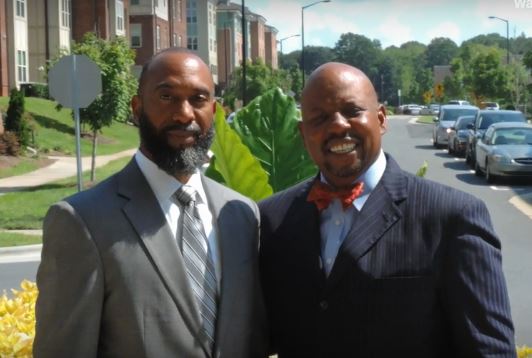
Anthony Scott, CEO of Durham Housing Authority (left) and A. Fulton Meachem, President & CEO of Charlotte Housing Authority (right) in Durham, NC.
CLPHA is pleased to see that our members are visiting each other’s communities to share knowledge, ideas, and best practices for preserving and strengthening their public housing portfolios and resident services.
In August, the Charlotte Housing Authority (CHA) hosted the Durham Housing Authority (DHA) and Durham city officials on a bus tour of Charlotte public housing properties. The Durham delegation also met with CHA staff, board members, and residents to discuss how Charlotte is transforming its housing portfolio and resident services through entrepreneurial efforts in real estate development, bond programs, property management, and family self-sufficiency programs. You can watch a video slideshow of the Charlotte & Durham meeting here.
In October, residents, staff, and board members from the Minneapolis Public Housing Authority (MPHA) traveled to Cambridge, MA to meet with Cambridge Housing Authority staff and tour public housing communities. MPHA learned from Cambridge about their ongoing, comprehensive public housing transformation financed through the RAD program, Low-Income Housing Tax Credits, and other funding tools. In a post-trip recap, MPHA said their residents expressed the importance of seeing and hearing for themselves that these programs did not result in displacement. In fact, said MPHA, “CHA residents were often able to simply move units and continue living in their building even as the work proceeded around them.” You can watch a video about MPHA’s trip to Cambridge here.
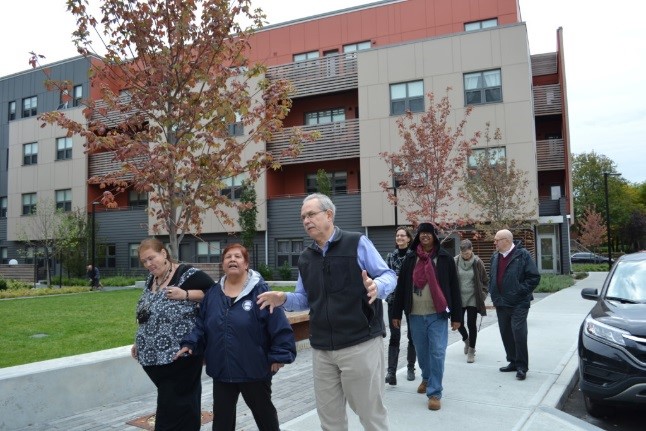
Representatives from the Minneapolis Public Housing Authority on a bus tour of Cambridge Housing Authority properties.
The Housing Authority of the City of Pittsburgh (HACP)will redevelop the vacant Larimer School, which is listed on the National Register of Historic Places, into 35 affordable housing units. This project is part of HACP’s larger Larimer/East Liberty Choice Neighborhoods redevelopment plan.
The Otto Bremer Trust awarded a $100,000 grant and a $500,000 low-interest loan to the Minneapolis Public Housing Authority (MPHA). MPHA will use the loan to support housing authority operations for its 6,000 public housing units and will use the grant to fund construction of the 16-unit Minnehaha Townhomes, slated to open in 2019.
From the Minneapolis Public Housing Authority's website:
For 35 years, the Korean Service Center (KSC) has helped residents age in place at MPHA’s Cedar High Apartments by providing culturally responsive, holistic support. From social services and in-home care to transportation and daily meals, KSC meets residents where they are and helps them remain independent.
“We are the one-stop shop for older Korean adults coming to Minneapolis,” said Kwangja Kwon, Executive Director of the Korean Service Center. “These residents rely on our daily routines and care to continue living here. We provide services that help them feel safe, supported, and at home.”
The organization began in 1989 after an MPHA intern recognized the need for a bridge between Korean residents and the social services they depended on. The Korean Service Center initially focused on helping Korean immigrants adjust to life in Minneapolis by offering English classes, citizenship application assistance, and a meal program.
Today, KSC continues to help residents navigate language and cultural barriers—no matter where they are from. Staff assist with housing applications, connect residents to social services, and partner with MPHA to complete annual housing recertifications. Center staff also provide transportation to medical appointments, helping residents navigate healthcare facilities and offering interpretation services along the way.
“Previously, when elderly residents received recertification paperwork, they didn’t know what to do with it,” Kwon said. “We help them gather the required documents and make sure everything gets back to MPHA. Our collaboration with MPHA is incredibly valuable because it makes a real difference for the residents.”
In 1999, KSC opened Grace Place, the nation’s first assisted living program for Korean Americans, located on MPHA’s Cedar High campus. With staff on-site, Grace Place supports dozens of older adults and people with disabilities through home care services, daily meals, and engaging social activities that help residents age in place.
Residents receive three traditional Korean meals every day of the year, with some ingredients grown in on-site gardens. The organization also promotes mental, physical, and social well-being through programs such as afternoon tea, art classes, weekly bingo, a community choir, walking groups, tai chi, and yoga. In 2025, a Highrise Health Alliance mini-grant helped fund a community choir performance.
As residents’ care needs grew, KSC launched the Sunflower Program in 2013 to provide 24-hour support on a dedicated floor of Cedar High. The program offers assistance with bathing, housekeeping, medication management, and other daily needs, allowing residents to remain in the community they call home. With the average participant now 87 years old, the program has become increasingly vital.
“The Korean Service Center has been an exceptional and long-term partner,” said Mary Boler, Director of Operations at the Minneapolis Public Housing Authority. “Their dedication and compassion in providing quality services to MPHA residents has enriched the lives of so many people, residents and staff alike.”
For many MPHA residents, KSC staff have become like family. They provide meals, transportation, personal care, and companionship while treating every resident with dignity and respect. For MPHA, the partnership ensures residents have the support they need to remain healthy, connected, and safely housed for years to come.
From the Chicago Housing Authority's press release:
The Chicago Housing Authority (CHA) today accepted a $2.3 million Jobs Plus Initiative grant from the U.S. Department of Housing and Urban Development (HUD), funding a five-year effort to connect working-age residents at Wentworth Gardens with employment services. CHA is one of only 10 agencies nationwide to receive the grant.
Jobs Plus is a place-based program built on three core components: employment-related services, a financial rent incentive, and community support. Through strong, sustained partnerships with local organizations, CHA will offer residents employment training, skill building, financial literacy training, and direct hire job placements. Program goals include increasing the number of residents who find employment, raising quarterly employment rates, and boosting resident income, with outcomes designed to outlast the five-year grant term.
This is CHA’s third Jobs Plus award, following grants at Altgeld Gardens (2015-2019) and Dearborn Homes (2021-2025). Wentworth Gardens program include the Wentworth Gardens Local Advisory Council, Chicago Cook Workforce Partnership, City Colleges of Chicago, Chicago Park District, and UI Health Miles Square are among those partners offering resources for Jobs Plus Participants at Wentworth Gardens this grant period.
The program’s impact is reflected in the staff it has helped build, as well as the residents it serves. Ethiah Williams first came to Jobs Plus as a participant and now leads as a Program Manager:
“Jobs Plus saw potential in me before I fully saw it in myself,” Williams said. “It gave me confidence, skills, leadership, and purpose. I am standing here today because someone invested in me, and now I have the privilege of investing in others.”
From the Barberton Community Foundation's press release:
Barberton Community Foundation’s Board of Directors approved $450,665 across 22 grants in the second of two 2026 competitive grant cycles. Including the total five-year commitment to Magical Theatre Company in this granting cycle’s only long-term grant, the Foundation’s current grants and future commitments from this grant cycle total $590,665.
“Each grant is connected to larger goals for our community’s success,” said Executive Director Josh Gordon. “We are investing in the organizations and partnerships that will help us develop systems that help children start strong, connect our residents to opportunity, strengthen family stability, and bring more activity to our downtown. That alignment and focus is how these grant dollars maintain Barberton’s momentum.”
The cycle begins with $142,500 for early learning, strengthening the network of families, educators, preschool providers, and community partners working to help Barberton children enter kindergarten ready to learn and thrive.
Summit Education Initiative received $57,500 for the second year of the Barberton Preschool Collaborative work supporting cradle-to-career education. The partnership supports professional development, curriculum alignment, kindergarten transitions, and better use of kindergarten readiness data. Funding will also help develop a Birth-to-Grade 3 dashboard so partners can identify and respond to trends affecting local children and families.
Child Guidance & Family Solutions received $35,000 for programs that help educators respond to challenging behaviors, strengthen children’s emotional and social skills, and support healthier parent-child relationships. The grant will also expand the Incredible Years® Parent and Child program to the organization’s Barberton office.
Two additional grants bring kindergarten preparation and family support directly into children’s homes. The Early Childhood Resource Center received $25,000 for SPARK, an in-home kindergarten readiness program for 3- and 4-year-olds. Building for Tomorrow, the nonprofit arm of Akron Metropolitan Housing Authority, received $25,000 for home visits, developmental screenings, readiness activities, and connections to community resources for children from birth to age 5.
From the Alaska Housing Finance Corporation's website:
On a blustery July day in Valdez, Alaska, community members, builders, developers and congressional representatives gathered in a neighborhood nestled beneath green mountains to celebrate the completion of 20 new affordable housing units that local residents will soon call home.
The July 8 ribbon cutting at Blueberry Terrace celebrated the completion of years of work, spearheaded by the Alaska Corporation for Affordable Housing, a subsidiary of Alaska Housing Finance Corporation, in partnership with the City of Valdez.
In 2011, the Alaska Legislature passed HB119 allowing AHFC to create a subsidiary to develop affordable housing throughout Alaska. As a subsidiary of AHFC, ACAH develops, manages, and operates affordable housing and provides services to support the mission of AHFC: providing Alaskans access to safe, quality, affordable housing. In addition to the latest development in Valdez, ACAH properties include a combined 208 units of housing in Anchorage and 58 units in Fairbanks.
The design at Blueberry Terrace aims to create the feeling of single-family properties for the residents while maintaining affordability. The development consists of 10 duplexes making each of the 20 units an end unit. The units are separated by garages, meaning that residents don’t share walls with their neighbors’ living spaces. The result is a cost-effective development that also enhances privacy.
Duplex design at Blueberry Terrace takes into account a range of housing needs – from Older Alaskans looking for a small and affordable space to help them maintain their independence to growing families looking for an affordable neighborhood to raise their children.
...
The property serves as evidence that partnership between local governments, investors and AHFC can help meet the housing needs of Alaskans. In Valdez, the lack of available and affordable housing is so severe that the Valdez City Council established housing availability as their top priority for 2025.
“We have more jobs than there are people in Valdez but we lack housing for middle and low-income families,” says Valdez Mayor Dennis Fleming.
“There was a big need for us to have housing in the community of Valdez and Alaska Housing was our partner in this.”
Senator Lisa Murkowski echoed this priority during her remarks at the ribbon cutting, commended the community for taking a tangible step toward addressing their top identified need:
“We can focus on healthcare or we can focus on education, or we can focus on tourism or what needs to happen within our fisheries. But at the end of the day, everybody who's involved in education, in healthcare, in tourism and fisheries – they all need a place to live. And so it all comes back to housing…So to the people of Valdez: you have led by example, you've set the standard today.”
From The Spokesman-Review:
Offering 240 units of affordable housing in the Dishman Hills area of Spokane Valley, the Orchard Vista Grand Opening marks the completion of an affordable housing project that broke ground this time last year.
A household qualifies for the affordable complex if gross income is at or below 60% of area median for the Spokane metro area. Under 2025 HUD figures, that is about $42,350 for one person and $48,400 for two.
“Our one-bedroom apartments are $1,165,” said Nicole Gose, a property manager at Orchid Vista Apartments. “At a regular market-rate property, you’d be looking at $1,500 to $1,600 a month.”
The project came in at roughly $68 million, receiving funding from the state, the city of Spokane Valley, Seattle Foundation’s Evergreen Impact Housing Fund, along with CitiBank and Washington Trust Bank.
“It’s the largest project that we’ve ever done in our history,” said Pamela Parr, the executive director of Spokane Housing Authority.
Out of 240 total units, 106 are currently leased, with 58 currently occupied. Gose expects the remaining units to fill up within the next few months. She says the project has been very efficient, in both speed and spending.
“We were able to produce the units for 30% less than it would have cost us otherwise by creating this public-private partnership with the Inland Group, and it was also delivered much faster,” Parr said of the contractor for the project.
Mayor Laura Padden praised the group for coming in under budget, saying that affordable housing is important in addressing the growing Valley population.
“As the city grows, there’s always a need for more housing at all levels, so this is one of the steps, and a pretty large number of units,” Padden said.
“We’re all for affordable housing and also homeownership, so we’re trying to go across the spectrum,” she said.
The site is also going to include a childcare center, which is planned at 4,500 square feet on the northwest corner of the complex. The SHA won $126,000 from the state for the center, which will be YMCA operated. The SHA estimates the site to include two classrooms of 18 to 20 children.